

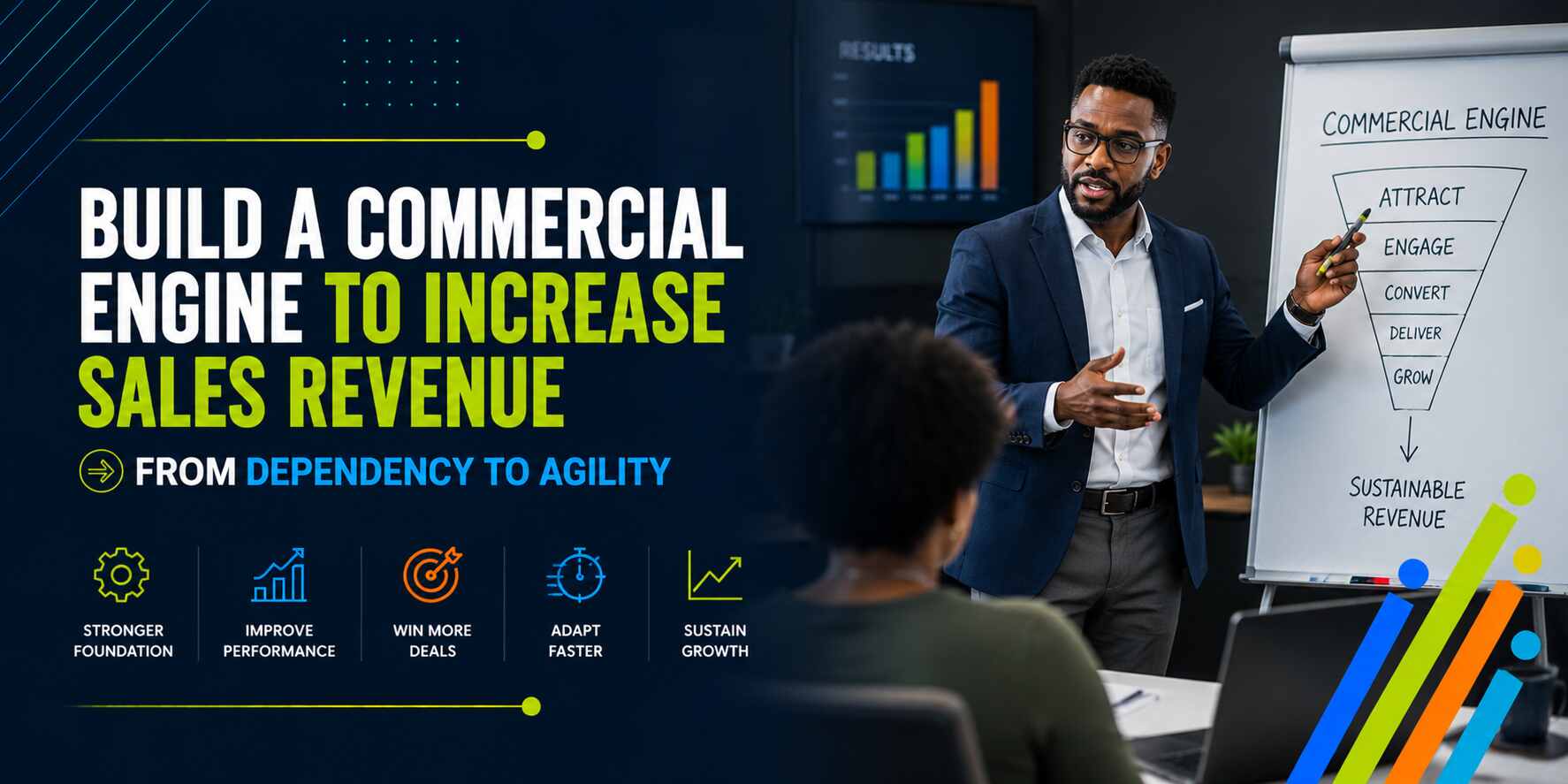
Build a Commercial Engine to Increase Sales Revenue
Across South Africa, and indeed much of the continent, many organisations share the same quiet dilemma. Contracts are steady, clients are loyal, and dashboards glow reassuringly green. Yet behind the data, revenue momentum has flattened. Teams work hard, but progress feels elusive.
Linchpin-PM Consulting refers to this condition as dependency equilibrium: a period where consistency conceals constraint. Whether it’s a manufacturer tied to one key distributor, a healthcare group reliant on reimbursements, or a professional-services firm dependent on an anchor client, the pattern repeats: reliability without revenue acceleration.
The issue is rarely effort or intent; it’s design. Sustainable revenue does not emerge from activity alone; it requires a commercial architecture that aligns information, behaviour, and leadership rhythm. This is where Linchpin’s Commercial Engine Framework comes in: a structured method for converting data and digital investment into measurable increases in sales revenue.
How Businesses Across Sectors Can Build Their Own Commercial Engine
1: The Trap of “Stable but Stuck”
In unpredictable economies, stability is seductive. It feels safe, until it isn’t.
Manufacturers cling to long-term supply contracts that limit responsiveness.
Hospitals chase compliance metrics but lose operational tempo.
Financial firms meet regulatory deadlines while missing profitability insights.
Public-sector suppliers rely on tenders that often disappear with each budget cycle.
What begins as resilience quietly becomes inertia. Across the African mid-market, organisations weather volatility but seldom design growth. Technology adoption rises, yet traction stalls. Marketing budgets expand, differentiation shrinks. Data accumulates, insight fragments.
The reason? Many leaders equate digital activity with commercial capability. True agility demands something deeper, a system that turns information into rhythm and rhythm into revenue.
2: The Real Problem Isn’t Sales, It’s System
When revenue plateaus, leadership instinctively blames sales: too few leads, too many stalled deals. But the real constraint sits beneath the sales function; it’s structural.
Sales teams chase opportunities without a shared playbook. Operations deliver without feedback. Finance measures revenue after the fact instead of guiding it in real time. The organisation moves fast but learns slowly.
Across Linchpin’s client base, one insight stands out: commercial weakness hides in information flow. When marketing data, operational reports, and executive decisions exist in separate silos, growth becomes accidental.
A Commercial Engine solves that fragmentation. It isn’t a CRM upgrade or a marketing campaign; it’s the alignment of people, process, and digital insight into a single performance loop that consistently increases sales revenue

3: Diagnose → Implement → Operate: The Architecture of Agility
Linchpin’s transformation method unfolds through three linked phases that move an organisation from reactive to rhythmic performance.
Phase 1: Diagnose, Make the Invisible Visible
Every transformation starts with visibility. Linchpin conducts a revenue and customer audit, mapping clients by value, frequency, and margin contribution, to reveal where resources create real return.
Often, the data reveals surprising truths: loyal customers who erode profits, or service lines whose hidden costs outweigh their revenue.
- Competency Focus: Data Intelligence & CRM Hygiene
- Growth begins when data becomes credible enough to challenge assumptions.
The outcome is clarity; leaders finally see where value is created, lost, or left unutilised.
Phase 2: Implement, Build the System
Insight must lead to structure. Implementation embeds the habits that sustain improvement.
Standardised Sales SOPs codify every stage of lead capture, qualification, and conversion.
Digital Transformation for sales revenue: Integrated CRM and marketing automation connect every client interaction.
Analytics dashboards transform operational noise into commercial foresight.
- Competency Focus: Digital Enablement & Sales Process Design
- Tools amplify discipline; they never replace it.
This phase turns isolated activity into coordinated rhythm, the heartbeat of increasing sales revenue.
Phase 3: Operate, Sustain and Scale
Transformation collapses when it relies solely on momentum. Linchpin embeds fractional leadership and governance routines that make progress measurable and repeatable.
Weekly commercial stand-ups replace static status meetings.
Dashboards ground discussion in data, not opinion.
Coaching converts managers into multipliers.
- Competency Focus: Leadership Enablement & Performance Rhythm
Agility isn’t a sprint; it’s an operating rhythm that keeps learning and revenue creation continuous.
4: Sector by Sector: How Dependency Disguises Itself
Dependency wears different masks, yet the underlying pattern and the route out are consistent.
- Manufacturing & Technical Services: Reliance on bulk contracts constrains flexibility. Integrating CRM and production data lets every order and downtime report feed demand forecasting, linking operations directly to revenue outcomes.
- Healthcare & Life Sciences: Hospitals often drown in compliance data while missing strategic insight. Connecting clinical, administrative, and financial metrics enables faster, safer, more profitable decisions.
- Financial & Professional Services: Compliance dominates attention; profitability disappears from view. Automating risk reporting and overlaying margin analytics exposes where the true value lies.
- Public & Environmental Enterprises: Tender dependency breeds volatility. ESG-driven storytelling and digital visibility attract private-sector clients while maintaining public-sector credibility.
Across sectors, the pivot point is the same: connected data, codified process, consistent leadership cadence.

5: The Competency Framework for Commercial Agility
Linchpin’s cross-industry experience condenses into five core competencies, repeatable capabilities that build commercial agility and sustained revenue growth.
Competency | Purpose | Before Maturity | Outcome After Transformation |
|---|---|---|---|
1. Data Intelligence | Establish a single source of commercial truth. | Conflicting reports, unclear profitability. | Unified dashboard, measurable insight. |
2. Digital Enablement | Automate and inform decision flow. | Manual spreadsheets, poor CRM adoption. | Connected workflows, real-time visibility. |
3. Sales Systemisation | Standardise conversion processes. | Dependence on “rainmakers.” | Predictable pipeline, collective capability. |
4. Leadership Cadence | Build rhythm and accountability. | Reactive meetings, blurred ownership. | Weekly progress measurement, empowered teams. |
5. ESG & Storytelling Alignment | Turn impact into differentiation. | ESG treated as cost. | ESG positioned as commercial advantage. |
Together, these competencies form the foundation of Linchpin’s Commercial Engine Framework, a blueprint any organisation can adapt to its reality.
6: Case Insight: From Tender Reliance to Market Agility
A mid-sized environmental-services firm illustrates the shift from dependency to agility. For fifteen years, it thrived on municipal tenders until delays triggered revenue droughts.
Linchpin applied its model step-by-step:
Diagnose: Analysed 400 clients by revenue and region, revealing dormant private-sector demand.
Implement: Introduced Sales SOPs, integrated CRM, and launched ESG-aligned campaigns.
Operate: Embedded fractional leadership to sustain rhythm and measure revenue impact.
Within six months, inbound leads tripled, conversion improved, and revenue diversified. What began as crisis management became a prototype for commercial renewal.
7: The Hidden Barrier Few Discuss
Most consultants focus on innovation or culture. Few address the unseen delay between information and action, what Linchpin calls management latency.
Across mid-market Africa, the average organisation takes 10–14 days to convert operational insight into executive action. By then, opportunity fades.
ERP and CRM investments shorten processes but not decisions. The next competitive edge is compressing latency, from weeks to hours. That is the essence of Commercial Intelligence: seeing sooner, deciding faster, executing better.
8: From Digital Transformation to Commercial Intelligence
Digital transformation modernised tools. Commercial Intelligence modernises thinking.
Instead of asking “Are we digital?” leaders now ask “Are we learning fast enough to grow revenue?”
Through Linchpin’s Lifecycle Intelligence™ approach, marketing, sales, service, and finance data form one feedback system. Every meeting becomes a forecast, every dashboard a decision.
When insight circulates continuously, performance compounds, and increasing sales revenue becomes the natural result of organisational learning.

9: Fractional Leadership, Scaling Capability Without Overhead
Building agility requires senior expertise, but permanent hires can strain margins. Linchpin’s Fractional Leadership Model provides seasoned executives on a part-time basis to guide transformation, coach teams, and transfer capability.
It delivers strategic depth without long-term overhead, a pragmatic bridge between ambition and affordability. For SMEs and mid-market firms, it turns intent into institutional capability.
10: Why This Matters Now
Regulation, volatility, and technological acceleration are converging. Boards no longer want thick reports; they need operating systems that think. Linchpin-PM Consulting positions itself not as a vendor of strategies but as a builder of commercial infrastructure, the partner that turns clarity into cash flow and data into increasing sales revenue.
The firms that master Commercial Intelligence will lead Africa’s next growth cycle. Those who remain dependent will watch opportunity pass in real time.
11: The Leadership Shift: From Control to Clarity
True agility isn’t about faster leaders, it’s about clearer ones. Control means knowing what happened yesterday; clarity means understanding what will happen tomorrow.
When data, digital, and people move in sync, leadership energy shifts from firefighting to forecasting. Teams gain purpose; executives gain confidence. Revenue follows rhythm. Agility, ultimately, is clarity in motion.
12: The Linchpin Lesson
Businesses don’t fail for lack of opportunity, they fail for lack of visibility. Across industries, one principle endures: if you can’t see your commercial engine, you can’t steer it. Visibility drives decisions; decisions drive revenue.
Building that visibility is no longer optional, it’s the foundation for resilience, relevance, and responsible growth across the continent.
13: Your Next Step: From Dependency to Agility
If your organisation is stable but stuck, it’s time to rebuild your commercial rhythm. Linchpin-PM Consulting’s Diagnose → Implement → Operate framework helps leaders design the systems that increase sales revenue and embed agility at the core of performance.