
Why Sales Revenue Suffers When Strategy, Structure, and Execution Drift
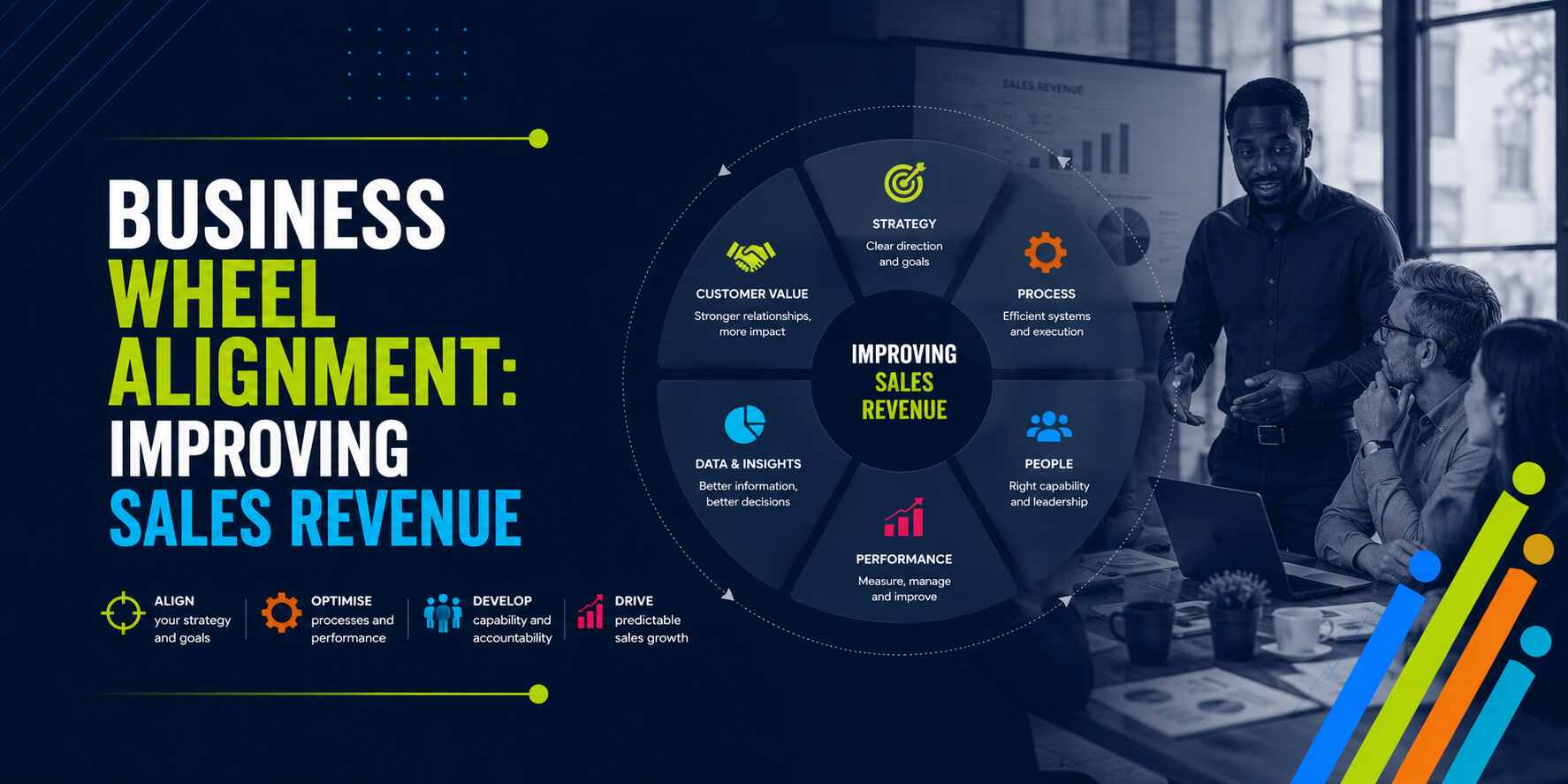
Improving Sales Revenue through Business Wheel Alignment:?
Sales revenue rarely collapses overnight. It erodes when strategy, structure, and execution drift out of alignment. At the beginning of most years, experienced drivers do something that looks almost boring in its practicality: they book their vehicles in for a wheel alignment. There is no drama prompting the decision. The car still drives. The engine still runs.
Nothing has failed in a way that demands urgency. Yet the driver understands something subtle but important, that motion and health are not the same thing, and that misalignment rarely announces itself loudly before it begins to extract a cost.
When wheels fall out of alignment, a car does not stop moving. It continues to travel forward, sometimes at speed, sometimes under load. What changes is friction. Tyres wear unevenly. Fuel efficiency declines. Steering requires constant correction. Over time, the driver grows fatigued without fully understanding why the journey feels harder than it used to. By the time failure becomes visible, the damage has already compounded.
Most businesses enter a new year doing precisely the opposite.
Instead of checking alignment, leadership teams increase pressure. New sales targets are approved. Execution plans are accelerated. Teams are asked to move faster, close more, deliver more, and absorb more complexity, all while the underlying structure of the organisation, how decisions are made, how work flows, how authority is exercised, and how performance is governed- remains unquestioned.
The business continues to move. Revenue still arrives. Customers are still served. But the cost of motion rises quietly, and sales are almost always the first place where that cost becomes visible.
Why Sales Revenue Is the First Signal of Misalignment
Sales revenue rarely fails suddenly. It deteriorates gradually, often disguised as market conditions, customer behaviour, or sales capability issues. Yet when examined closely, many sales problems are not sales problems at all. They are structural problems that surface through the sales function because sales sits at the intersection of promise and delivery.
When strategy, structure, and execution drift apart, sales teams are forced to operate inside ambiguity. Pricing decisions become inconsistent because governance is unclear. Delivery timelines become uncertain because operations are compensating rather than executing predictably. Sales leaders spend more time escalating issues than managing pipelines. Forecasts lose credibility, not because people are dishonest, but because the system itself is unstable.
In these conditions, organisations often respond by attempting to improve business sales performance through isolated interventions. They adjust incentives, refine scripts, invest in product online marketing, or introduce new CRM tools. While these actions increase activity, they rarely restore reliability. Sales effort intensifies, but results remain volatile.
This is the organisational equivalent of accelerating a car with misaligned wheels. You can drive faster, but the wear increases and control diminishes.

Alignment Is Not Strategy, It Is the Condition That Allows Strategy to Work
Strategy answers the question of direction. Alignment answers the question of whether the organisation can move in that direction without internal resistance.
An aligned operating model ensures that decision-making authority matches accountability, that governance protects value under pressure, that execution flows without constant escalation, and that leadership effort compounds rather than compensates. When alignment is present, sales systems function as intended because promises made externally are supported internally.
When alignment is absent, leaders become human shock absorbers. They step in to resolve disputes, override processes, reassure customers, and unblock work that should never have stalled. Over time, leadership capacity is consumed by compensation rather than direction, and the organisation becomes increasingly dependent on individuals rather than systems.
This is why alignment is not a transformation initiative or a one-off project. It is a diagnostic discipline that determines whether the organisation is structurally capable of sustaining performance.
What an Organisational Alignment Check Actually Examines
A mechanic does not check wheel alignment by asking how ambitious your travel plans are. They examine angles, tolerances, wear patterns, load distribution, and the interaction between components. Similarly, an organisational alignment check does not begin with goals. It begins with reality.
The Linchpin Diagnostic is designed to surface how an organisation actually behaves under pressure, not how it is described in strategy decks or policy documents. It examines how decisions are made, where authority truly sits, how work moves across boundaries, how performance is measured, and where dependency has accumulated.
This diagnostic is structured around the 7-Pillar Linchpin Framework™, a codified operating and leadership system that reflects how organisations move from chaos to coherence.
Each pillar addresses a specific form of drift, and each builds logically into the next.
Cultivate: Seeing the Organisation as It Truly Operates
Cultivation is the discipline of diagnosis. It requires leaders to suspend assumptions and observe reality. This pillar exposes informal power structures, hidden workarounds, unspoken rules, and misaligned incentives that quietly shape behaviour.
Without cultivation, organisations solve the wrong problems with great enthusiasm. With it, leaders finally answer the question that underpins every effective intervention:
– What is actually going on here?

Steward: Protecting Value Through Governance, Not Control
Once reality is visible, governance becomes unavoidable. Stewardship is not about bureaucracy; it is about clarity. It defines which decisions matter, who holds authority, and which boundaries cannot be crossed without consequence.
When stewardship is weak, sales teams feel it immediately. Exceptions multiply. Pricing drifts. Commitments are renegotiated under pressure. Revenue becomes fragile because rules change when urgency rises.
Strong stewardship stabilises sales not by restricting movement, but by protecting consistency.
Be Fruitful: Measuring Outcomes Instead of Effort
Many organisations track activity exhaustively while remaining uncertain about results. Teams are busy, reports are full, and meetings are frequent, yet outcomes remain inconsistent.
Fruitfulness introduces discipline into performance measurement by distinguishing between effort and impact. It asks whether results improve because the system works, or because individuals are compensating for its weaknesses. This distinction is critical for sales management, where motion can easily mask structural fragility.

Multiply: Removing Dependency on Individuals
Misalignment becomes unmistakable when key people step away. If decisions stall, deals pause, or customers sense uncertainty, capability has concentrated rather than multiplied.
Multiplication designs decision rights, competence, and accountability into the organisation so performance continues without constant executive involvement. This is where founder dependency dissolves, and sales capacity becomes institutional rather than personal.
Replenish: Restoring Depleted Capability Before Breakdown
Pressure consumes capacity quietly. Skills age. Systems lag behind reality. Teams adapt heroically until exhaustion sets in.
Replenishment identifies where capability has thinned and restores it intentionally. This is preventative leadership, and it directly influences sales reliability because depleted systems cannot support a consistent customer experience.
Subdue: Reducing Structural Complexity
Complexity is rarely designed. It accumulates through unmanaged change, exceptions, and workarounds. Over time, execution becomes harder than necessary, and sales cycles lengthen without a clear reason.
Subduing complexity restores flow by simplifying decision paths, clarifying ownership, and removing unnecessary friction.
Have Dominion: From Reaction to Strategic Influence
When alignment is restored, leaders regain the ability to shape rather than react. Sales messaging sharpens. Market positioning stabilises. The organisation stops chasing symptoms and starts directing outcomes. Dominion is not dominance. It is a strategic agency.
Where Linchpin Consulting Fits
We operate as your commercial architecture and capability firm. We exist to assist you with how your organisation operates, so performance becomes repeatable, leadership is distributed, and results are not dependent on individuals.
Through a codified operating framework, Linchpin diagnoses organisational misalignment, designs operating and governance systems, and embeds execution capability across sectors. This is operating model consulting in practice.
👉 Book a consultation with Linchpin today!

Let’s Work Together