

Your Business Is a Learning System. Is It Getting Better?
Every business is teaching its people something, every single day, whether anyone in the business has ever stopped to think about it that way or not.
The real question was never whether your team is learning, because they are learning constantly just by watching how things actually happen around them. The question that matters is what, exactly, your business is teaching them to do.
- – Are they learning how to solve a problem on their own, or are they learning to walk it straight to your office?
- – Are they learning how to serve a customer properly the first time, or are they learning that customers wait until someone more senior gets involved?
- – Are they learning how to make a sound decision, take real responsibility, and think for themselves, or are they learning that the safest move is always to check with the owner first, that problems only get fixed once somebody complains loudly enough, that important information lives nowhere except in one person’s head, and that the fastest way to get anything done is a WhatsApp message straight to the boss?
Whatever happens repeatedly inside your business becomes a lesson, and whatever becomes a lesson for long enough simply becomes the way your people work. That is why your business is already a learning system, regardless of whether you ever designed it to be one. The real question is not whether that system exists. It is whether the system you already have is making your business stronger, or whether it is just teaching everyone the same coping mechanisms for the same recurring problems.
Your business is probably training people every day.
Think honestly about what happens the moment a customer has a problem. If your employee already knows exactly what to do, understands the standard you expect, has been given the authority to actually solve it, and can move through the process without needing to phone you first, then your business has taught that person something genuinely valuable. But if instead the employee’s instinctive response is “let me check with the owner,” and that same response plays out ten times in a single day, then something has been taught there too, just not the thing you wanted.
That employee has learned that decisions belong to the owner and that taking responsibility carries more risk than simply escalating the problem upward. And you, in turn, have learned that you can never quite switch off, because everything still seems to need your sign-off before it can move. Nobody necessarily did anything wrong here. The business simply taught everyone, through repetition rather than intention, how it actually works.
This is exactly where so many growing businesses get stuck, because the owner is thinking “my people need to start taking more responsibility,” while the employee is quietly thinking “the owner clearly wants to control everything anyway.” The owner concludes that nobody can do the job properly without their involvement, while the employee concludes that there is little point making a call when the boss is likely to change it regardless. Around and around it goes, each side reading the same pattern as confirmation of what they already believed.

The problem is not always your people
When performance in a growing business starts to slip, the instinctive response from most owners is to assume they simply need better people. Sometimes that is true. But far more often, the people already on the team are doing their best inside a business that has never clearly shown them what success actually looks like or how to get there.
Picture hiring a genuinely good salesperson and then handing them no defined sales process to follow. Picture bringing on a capable administrator and never giving them real ownership over the information they are responsible for managing. Picture promoting someone into a supervisor role and never once training them in how to actually manage other people. Picture asking your team to “take more ownership” while every decision of any real weight still has to travel back through you before anything can move forward.
You cannot simply instruct people to become capable and expect the instruction alone to change anything. You have to actually give them the opportunity to become capable, which means clear expectations, tools that work, practical training that sticks, the real authority to make appropriate calls, and enough repetition over time for genuine skill to develop. This is where two words carry far more weight than most business owners give them credit for: capacity and capability.
Capacity and capability are not the same thing
These two words sound close enough in everyday conversation that most people use them interchangeably, but they describe two entirely different problems inside a business.
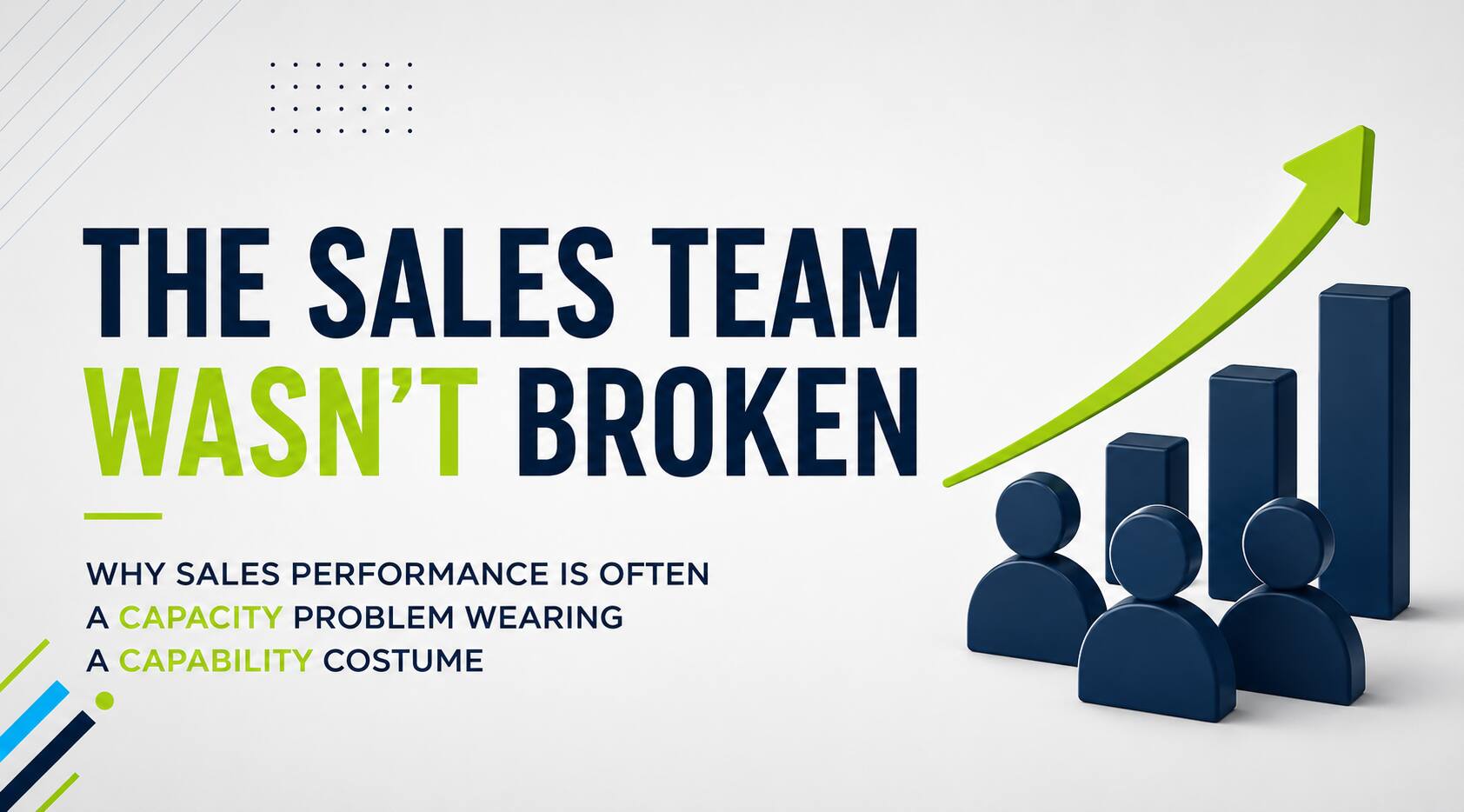
Capacity is a measure of how much your business can physically handle at any given time, while capability is a measure of how well it can actually handle it.
Here is a simple way to picture the difference. Imagine you have ten employees and ten customers, and on paper you would say you have enough people for the workload in front of you. That is capacity.
But if every single customer problem still lands back on your desk, every quote still needs your personal sign-off, every salesperson still needs you in the room to actually close the deal, and every employee is still waiting to be told what happens next, then you may have plenty of people without anywhere near enough capability.
Now picture the opposite scenario, where a much smaller team knows exactly what their job requires, understands what good work actually looks like, knows precisely which decisions belong to them, knows when something genuinely needs to be escalated, and knows how to serve a customer, record information properly, follow a defined process, and solve the problems that come up most often on an ordinary day. That smaller team may carry less raw capacity than the larger one, but it very likely carries far greater capability.
Capacity answers the question “how much can we handle?” Capability answers the far more important question of “how well can we actually handle it?” You can buy capacity relatively quickly, usually just by hiring another person. Capability takes considerably longer to build, because it comes from real experience, deliberate teaching, clearly defined processes, consistent leadership, genuine practice, and accountability that is actually followed through on.
This distinction matters enormously, because so many owners try to solve a capability problem by simply buying more capacity: hiring another person, buying another system, adding another layer of management, outsourcing a function, or working even longer hours themselves. When the underlying way the business operates has never actually taught people how to work properly, all of that additional capacity often just means more people doing the same confused work at a slightly larger scale.

Your people are learning from you, even when you are not teaching
The owner is very often the single strongest teacher inside the business, not because they are standing in front of anyone delivering a lesson, but because everyone else is constantly watching what the owner actually does. If you personally answer every customer complaint, your team learns that customer problems belong to you. If you make every decision of consequence yourself, your team learns that decisions belong to you too. If important information only ever lives in your head, your team learns that this is simply where information is supposed to live. If priorities shift every Monday morning, your team learns that whatever plan exists today is only ever temporary.
If you reward people for solving problems but never actually give them the authority to solve them independently, they learn that responsibility has been handed to them without the control needed to carry it properly. If you tolerate poor follow-up without addressing it, your team learns that follow-up is essentially optional. And if you consistently keep the promises you make to customers, your team learns that reliability genuinely matters here. Your people are watching everything, all the time, and your business is teaching them constantly through what it actually does rather than through what anyone says out loud. The real question is simply whether those lessons are the ones you intended to teach.
This is why founder dependency becomes so expensive
Most business owners begin by doing almost everything themselves, and there is a very good reason for that: at the very beginning, there is often quite literally nobody else to do it. You sell, you quote, you answer the phone, you deliver the work, you solve the problems, you collect the money, you speak directly to every customer, you manage every supplier relationship, and you make every decision because you are the entire business.
Then the business grows, but the way it actually operates does not always grow along with it. The owner remains the person everyone still goes to for everything, and at five employees that might still be manageable, if exhausting. At fifteen employees it becomes genuinely draining, and by thirty employees it can become outright dangerous, because the business now carries far more customers, more staff, and more moving parts than before, while the owner is still sitting squarely in the middle of every single one of them. The owner has effectively become the bridge connecting every part of the business, and bridges are built to carry weight, but eventually, under enough pressure, something starts to crack.
The answer to that pressure is rarely “work even harder.” Sometimes the real answer is building a business where the weight is genuinely shared across more than one set of shoulders.

Stop asking, “How do I get my people to work harder?”
Ask a far more useful question instead: what does my business actually need to teach people so they are equipped to carry more responsibility? That single shift in the question changes almost everything downstream of it. Instead of concluding “my staff aren’t taking ownership,” start asking whether you have ever clearly defined what it is they are actually meant to own. Instead of concluding “my salespeople can’t close,” ask whether they have been given a real sales process and enough genuine practice to get good at it.
Instead of concluding “nobody knows what’s going on,” ask where the relevant information is actually supposed to live in the first place. Instead of concluding “I have to check everything myself,” ask which decisions genuinely still need to be yours at all. And instead of jumping straight to “I need more staff,” ask honestly whether what you are facing is actually a capacity problem or a capability problem, because the fix for each one looks completely different.
Build capability before you keep adding capacity
None of this means you should never hire another person, because there will absolutely be moments when the workload genuinely demands it. But before adding headcount, it is worth looking carefully at the work already happening inside the business right now.
- Where does the pace consistently slow down?
- Where does someone always have to stop and ask for help before they can continue?
- Where do you personally have to step in for things to move?
- Where do customers routinely experience delays they should never have to sit through?
- Where do the same mistakes keep repeating themselves?
- Where does important information disappear the moment one person is out of the office?
- Where does nobody seem entirely sure who is actually responsible?
- Where does the same question keep getting asked, over and over, by different people, week after week?
Every one of those is a clue, pointing to exactly where your business is struggling to carry its own weight, and every single one of them is also an opportunity to teach the business, and the people inside it, how to work better.
- You can document the process properly.
- You can train the specific person who needs it.
- You can clarify who is actually responsible for what.
- You can hand over real authority rather than just the appearance of it.
- You can build a simple checklist that removes the guesswork.
- You can make important information visible to the people who actually need it.
- You can measure the things that genuinely matter and review the results honestly.
Then you improve it again. That, repeated over time, is how real capability grows, not through a motivational speech delivered once and forgotten, but through repeated practice supported by a genuinely better way of working.

What happens when capability grows?
Something quietly significant starts to happen: the owner gets their business back, not because they stopped caring about it, but because other people around them have become genuinely capable of carrying real responsibility. The salesperson can now handle far more of the sales conversation without needing you in the room. The supervisor can resolve far more operational problems without escalating them.
The administrator can manage information without you needing to check behind them constantly. The manager can actually manage. The team can make appropriate calls on their own, and customers experience more consistent service as a result, because problems get solved much closer to where they actually happen. The owner, freed from constantly putting out yesterday’s fires, finally has room to think properly about where the business is actually going rather than only where it has already been.
That is what a genuinely stronger business looks like. It is not necessarily a bigger business at all. It is simply a business that can carry more responsibility without every ounce of that weight running back through the owner personally.
Your business is already teaching people. Make the lessons count.
Here is the opportunity most business owners quietly miss: you do not need to build the perfect company, and you certainly do not need a hundred-page operations manual or another complicated system layered on top of everything else. Start instead with the work that is already happening every single day. Find the specific places where people consistently get stuck. Find the decisions that always seem to travel back to you regardless of who is meant to own them. Find the customer problems that keep repeating in exactly the same way. Find the pieces of information that only one person in the whole business actually knows. Find the tasks that get done differently depending entirely on who happens to be doing them that day.
Then ask one simple, clarifying question: what would need to be true for somebody else to handle this well without me being involved at all? That single question is what carries a business from dependency toward genuine capability. It is what turns your own hard-won experience into something the whole business can actually use, and it is what slowly transforms what only you know into something your team can learn for themselves, until eventually individual knowledge becomes organisational strength that no longer depends on any one person being in the building.
The goal is not to remove the owner. It is to stop making the owner the system.
- Your experience still matters.
- Your judgement still matters.
- Your relationships still matter.
- Your leadership still matters, more than almost anything else in the business.
- But the business itself should never require your personal presence just for it to function on an ordinary day.
The goal here was never to make you irrelevant. The goal is to make what you already know transferable to the people around you.
If you know how to win a customer, teach the business how it is actually done. If you know how to solve a genuinely difficult problem, teach someone else how to think it through. If you know what good service actually looks like, define it clearly enough that others can recognise it too. If you know which numbers really matter, make them visible to the people who can act on them. And if you know exactly where the business keeps getting stuck in the same place, fix the actual reason it keeps getting stuck there rather than simply stepping in to unstick it yourself every time.
That is how a business genuinely gets stronger, and it is precisely why every business, whether it has ever been designed this way on purpose or not, is a learning system. Your people are learning from what you say, from what you actually do, from what you tolerate without addressing, from what you choose to measure, from what you reward, and from what happens whenever something goes wrong. So the real question was never “are my people learning?” because they already are, every day, with or without your involvement. The better question, the one worth sitting with honestly, is this: is my business teaching people how to build something that can perform without everything depending on me?
Because when people become genuinely more capable, the business can carry more. And when the business can carry more, the owner no longer has to carry everything alone. That is the real difference between simply having people on the payroll and building a business that actually knows how to work.
Linchpin Consulting helps South African business owners identify where their business is getting stuck, strengthen the way people work, and build the capability required for stronger, more consistent performance.
If your business is growing but too much of it still depends on you personally, the right place to start is a conversation.
Book a Sales Performance Strategy Call Below.
One conversation. Clear answers. No complicated language. Just a practical, honest look at what is actually getting in the way, and what you can do about it.
Let’s Work Together